
Miami erased a three-goal, first-period deficit to pull even with Niagara at Cady Arena on New Year’s Eve.
Then, with 20 seconds left, the puck popped loose during a tie-up behind the RedHawks’ net, and Shane Ott emerged from the scrum and centered to a streaking Albin Nilsson, who shoveled a one-timer through RedHawks goalie Ludvig Persson to win the game for the Purple Eagles.
The following week Miami went to Denver and was blanked, 7-0 back-to-back nights. The RedHawks won just one time once the calendar flipped, finishing 1-14-2 in their final 17 games.
(Hilarious coincidence: Nilsson transferred to Miami and will suit up for the RedHawks in three months)

So what happened, and more importantly, how do the RedHawks flip this Sisyphean script they seemingly repeat every winter?
Both head coach Chris Bergeron and athletic director David Sayler refused comment, but here are a few thoughts about both ends of that most axiomatic of questions surrounding the Miami hockey program.
What happened? Well, we’re not paid coaches nor do we play them on TV, but having watched this program for nearly 30 years, we’d have loved to have asked about a couple of observations through our lens.
— NCHC intimidation? Miami won three of 24 conference games last season and was outscored, 96-39 in league play. That’s an average final score of 4-1 1/2. The team looked intimidated in its 14-0 weekend drubbing at Magness and wasn’t competitive in far too many games for the balance of the campaign.
And that wasn’t much of an aberration for the Bergeron era. The RedHawks are 17-68-9 in league play since 2019-20 for a .229 NCHC winning percentage.
In fairness, Miami won league games at just a .328 clip the previous four seasons, so conference struggles are not limited to the current regime, but they have worsened.
This coaching staff, which ultimately took Bowling Green to the NCAA Tournament in 2019, snapping a 29-year drought for the Falcons, took over after Enrico Blasi was fired and was never shy about its desire to rejoin the CCHA, under which it had thrived with the Falcons and in Oxford, where Bergeron was an assistant before Miami joined the NCHC.
So has that negativity rubbed off on the players, who have rivaled Jekyll and Hyde polarity levels in non-conference vs. conference contests the past four seasons?
— Conditioning? Miami allowed at least five goals in each of its final four games and surrendered markers in each of its final 12 periods. Opponents recorded at least five goals eight times during the RedHawks’ final 17-game slaughterfest.
And this team had better depth than the previous two seasons, meaning the time on ice was more balanced, so MU skaters were certainly not overplayed.
Yet it looked like far too often the RedHawks were gassed in the closing minutes.
— Scouting? Dating back to the final years of the Blasi administration, NCHC opponents have seemed to adjust to the RedHawks’ style of play while Miami has not done the same. Probably why the RedHawks may have set an all-time organized-hockey record for hat tricks and natural hat tricks against in 2022-23.
North Dakota is a prime example last season. Miami salvaged a split in Grand Forks last season but was obliterated in Oxford later in the year. It seemed like UND anticipated every RedHawks pass and the Fighting Hawks were able to elude every MU defender the final two games.
— Internal leadership? In terms of a true captain, Steven Spinell was the last Miamian to truly exude those qualities. Several others filling that role in the 10 years since Spinell graduated have been great players and great people but not the leaders the team has desperately needed.
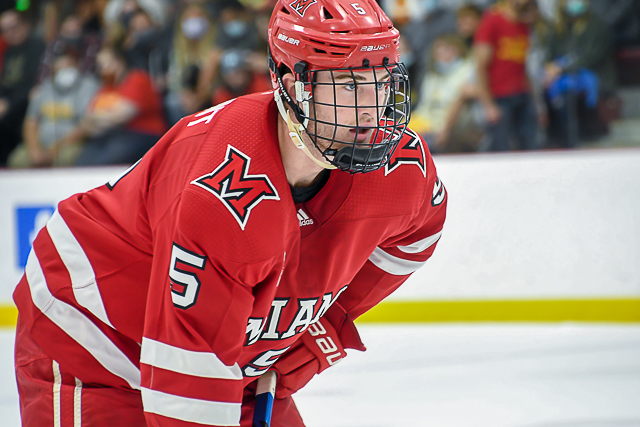
And as importantly, depth of leadership has been a struggle. Jack Clement has been a great captain by all accounts, but notice how many players Bergeron has hung the ‘A’ on since moving to Oxford four years ago (spoiler alert: It’s zero).
So how does Miami turn it around?
— Recruiting. Well, duh. At this point it’s fair to say the Eric Rud hire in that role was not a good one. He came from the women’s game where he was very successful, but he was supposed to be the one with the NHL connections, and obviously that didn’t pan out (not to mention Miami’s record as one of the worst defensive teams in the NCAA under his watch).
He’s a workhorse and a very nice man who we wish the very best as a USHL head coach, but he underdelivered with the RedHawks. Barry Schutte needs to land more quality players. Second-year assistant Zack Cisek built a solid reputation at Lake Superior State and will hopefully drive more talent to Oxford. Miami already has two quality commits for 2024-25.
— Better development of current players. Of the veteran members of 2022-23 roster, name one player who improved from the previous season. This coaching staff needs to figure out how to develop existing players, and do it quickly. Even more disturbing, several members of the quality freshman class regressed toward the end of the season.
— Defense, defense, defense. Miami allowed three more goals than any other Division I team in the NCAA, and based on its just-released 2023-24 roster, the RedHawks will once again be outmanned most of the season, so it’s imperative they defend better, meaning the forwards, defensemen and goaltenders.
Forwards need to backcheck, defensemen need to stop getting caught out of position and goaltenders need to stop pucks at a better clip than .889, tied for ninth-worst in college hockey.
A team lacking the offensive weapons to compete with the top-10s of the world needs to slow the game down and win 2-1 games.
Too often the past couple of seasons Miami has tried to run and gun with much more talented foes, and it has rarely ended well.
It’s MU’s fifth season under Bergeron, meaning every player on the 2023-24 roster was brought in by the current coaching staff.
COVID made the process of rejuvenating the RedHawks much more difficult early into his tenure.
But Bergeron took the team over in March of 2019, pandemic restrictions have long passed and there’s no reason this team shouldn’t be competitive in the NCHC this season.
By the way, Bergeron has 23 months left on his nearly $2 million, six-year contract which contains a one-year, $325,000 buyout for early termination.
It was a bad year for the coaching staff, but Bergeron has won everywhere he’s ever gone as a player and a coach.
As captain, he led Miami to its first-ever NCAA Tournament in 1993. After a seven-year pro career, he joined the RedHawks as an assistant and was a key recruiter during both of the RedHawks’ Frozen Four seasons in 2009 and 2010.
And as head coach, Bergeron saved Bowling Green from potential extinction, leading the Falcons to an NCAA berth in 2019 before accepting the same title in Oxford.
But he’s running out of time to keep his adulthood-long success streak alive at Miami.

 View From the Glass
Great analysis… Let’s go execute 2023-24 RedHawks! It’s your time to bring back The Brotherhood and at least leave everything you got on the ice every night!
LikeLiked by 1 person
I was a grad student from ’12 to ’14. The teams then felt like they had an identity and purpose. I was able to watch last season, and it looked like the team was just a bunch of players coincidentally wearing the same jersey.
LikeLike