
In the post COVID era, graduate seniors in college hockey are seemingly more plentiful than Zambonis at a rink.
But 13 years ago, when Marc Hagel came to Oxford, the concept was foreign to most NCAA fans.
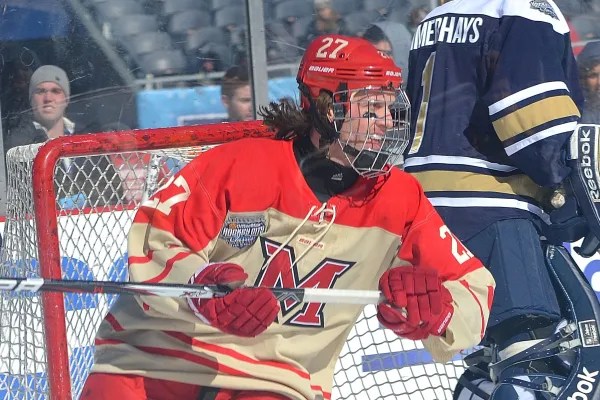
For the Miami hockey program, Hagel was a field pioneer, a grad senior before it was cool.
“It was really rare,” former RedHawks coach Enrico Blasi said. “The only way it happened is if someone was redshirted because of an injury or something like that.”
That fifth year of college led to Hagel’s admittance into one of the most elite schools in Canada and a career of helping people deal with injuries like the one he overcame in college.
And though he only spent one season at Miami, Hagel played a major role on one of the great teams in RedHawks history, fitting a career’s worth of experiences into his brief MU career.
“It’s a great school,” Hagel said. “I came from Princeton, and then you go to Miami, and it’s an incredible experience too. Princeton’s got a great campus, and Miami’s got an incredible campus too. Wonderful place, good people – Midwestern people are awesome and super friendly. I loved it there, everything about it.”
Prior to college, Hagel, who grew up in Hamilton, Ontario, an hour south of Toronto, exploded for 82 points in 49 games for his hometown OPJHL Red Wings in his age 19 season.
Thanks to his outstanding SAT scores and 95 average in high school – one of the tops in his class – the Ivy League called, and Hagel answered. Princeton, which was already acquainted with the family, recruited Hagel to join its program in the fall of 2008.
Marc’s older brother, Kyle Hagel, graduated from Princeton the spring before Marc moved in, so the Tigers enjoyed eight consecutive seasons of Hagel forward production.
“Princeton picked me, that was not a decision on my end,” Hagel said. “Once they picked me, I was going.”
But after racking up 10 goals in 51 games his first two seasons, Marc sustained five concussions in a span of a month as a junior.
As a result, he dressed just three times for the Tigers in 2010-11.
“You’re non-functional,” Hagel said. “I managed to get my schoolwork done somehow, some way, but other than that I was just laid up. It’s no one’s fault – what happened to me happened to me – but they didn’t know how to treat me, so I kept sitting in a dark room.”
Hagel, desperate to continue his hockey career, turned to a chiropractor in Boston, who was the father of one of his Princeton roommates.
The process of chiropractic adjustment was extremely tedious, requiring three treatments a day for 90 days, but finally Hagel was cleared to play.
“I got healthy and played a helluva lot more hockey,” Hagel said.
Hagel appeared better than ever his senior campaign, going 7-11-18 in 32 games with Princeton, and he had researched how to recuperate that lost junior season.
“(The NCAA) was being somewhat compassionate to head trauma around this time, they were sort of in vogue,” Hagel said. “I was like, I think I can get this year back, if I petition.”
The NCAA ultimately awarded Hagel a red shirt, but Hagel earned his Princeton degree on time, and to maintain academic vigor, Ivy League schools prohibit graduated players from participating in varsity sports.
So if Hagel wanted to play a fifth collegiate season, he would have to go elsewhere.
Princeton had reached out to Miami about Hagel’s situation, and after traveling to Oxford for an official visit – thanks largely to the recruiting effort of then-assistant coach Brent Brekke — Hagel chose Miami over both Denver and Northeastern.
Dr. Phil Russo, a long-time political science professor who retired as a department head at Miami a couple years ago, told Hagel to apply to his Master’s program, and Hagel joined as a teaching assistant (Hagel ultimately gave him his jersey from his game at Soldier Field).
The 2012-13 RedHawks were extremely talented but also very young, with goalies Ryan McKay and Jay Williams both freshmen and Austin Czarnik, Sean Kuraly, Riley Barber all under the age of 20. Blake Coleman and Jimmy Mullin were both sophomores.
Hagel, who turned 24 a month before the season started, was the second-oldest RedHawk.
“It was a natural fit for us because if you remember, that year we had a big freshman class,” Blasi said. “We had the Kuraly class, and Coleman and Czarnik were sophomores. It just worked out because he was a leader, he was older, solidified our team a little bit.”
And in an era where roster turnover was fairly limited and players typically stuck with their schools for four seasons, Hagel was immediately welcomed to the team. That was due largely to the leadership of Steven Spinell, who Blasi called one of the best captains he’s ever coached.
“Spinell did an unbelievable job of bringing that team together and making sure Marc was accepted,” Blasi said. “And Marc’s smart, he knew how close the team was, he knew how good we could be, he knew that Steven was the captain, and he was a complement to Steven. It just all worked well together because of our culture and our identity, so I think he fit in really, really nicely.”
Hagel didn’t find his way onto the scoresheet often the first half of the season, registering two goals and three assists through 26 games, but he still played tight defense and was a key penalty killer.
“Even though he wasn’t scoring, he was still very much in the mix of what we were doing,” Blasi said. “We were winning games early that year — you don’t win the league without winning games early, and you don’t win the league without everybody contributing in one way or another.”
Said Hagel: “At one point I started slipping down the lineup a little bit, and Rico saw it on my face. He said don’t worry about it, I’m not taking you out of the lineup, so that kind of calmed me and down and from there I could just kind of just play my game. If you look down (that team’s) lineup, how many guys are still in the NHL having great careers? So there wasn’t really any room for me other than 5-on-5.”
Then he racked up five assists in a home weekend sweep of Alaska en route to tallying 14 points in his final 16 games, including an assist on Miami’s CCHA quarterfinal series-clinching goal vs. Michigan State and a goal in the RedHawks’ 4-0 win over Minnesota State in their NCAA regional semifinal in Toledo, the last Division I tournament game MU has won.
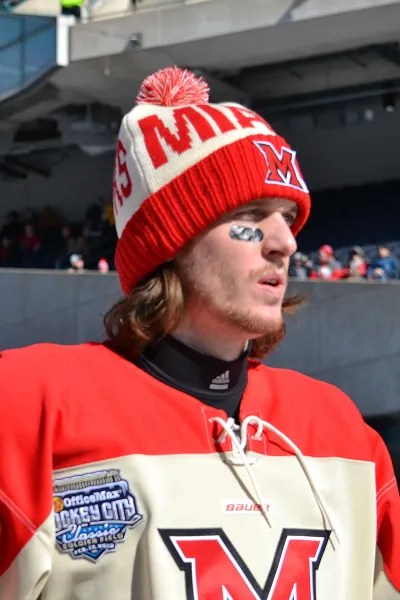
He also picked up the primary helper on Miami’s only goal in the team’s first-ever outdoor game, a 2-1 loss to Notre Dame at Soldier Field.
One of only five RedHawks skaters to dress for all 42 games that season, Hagel finished 6-13-19, tied for fourth on the team in assists and even with Coleman for sixth in points.
Hagel’s two-way play helped Miami hold its opponents to just 73 goals all season, a clip of 1.73. Both are program bests.
“(Defense) was our identity, right? So he fit our identity nicely,” Blasi said. “Marc was the kind of guy you could play up and down the lineup. You could play him the power play, he could kill penalties – so it was a real benefit to our team.”
He played all three forward positions and held his own in the faceoff circle when needed.
“We had (forward depth), but it was young, and they needed to develop,” Blasi said. “So that’s where a guy like Marc was really good because he was a professional about his preparation, the way he approached practice, his attitude, he was another captain even though we didn’t give him a letter. He helped Steven kind of solidify the room.”
With four collegiate seasons under his belt, Hagel was another much-needed veteran leader on an underclassman-heavy team.
“If (the coaches) would talk about certain things that happened with our guys, he would just say, ‘I’ll talk to them’, and kind of had a smile on his face because he knew he could get to them,” Blasi said. “Steven had to be the big picture guy because he was the captain, but Hags could (say), ‘hey, what are you doing, smarten the eff up, you’re pissing it away here, you know’? Or he could say, ‘hey John, you understand what Coach just said there, right? He’s not on you, you’ve got to listen to him. He wants what’s best for you’. Stuff like that.”
And Hagel enjoyed his teammates and coaches as much as they appreciated them.
“Everybody was great – all of them,” Hagel said. “We had a great team, we all got along so well, we had a ton of fun. Looking back on that year, if we could’ve gotten past that Elite Eight, that could’ve been it, but we didn’t.

Five years after Hagel earned his Master’s at Miami, the RedHawks added transfers goalie Jordan Uhelski and defenseman River Rymsha to their 2018-19 roster as graduate seniors, and recent RedHawks standouts like Jack Clement, Hampus Rydqvist and Dylan Moulton were awarded an extra year due to COVID and played five seasons in Oxford.
But Hagel was Miami’s first, and with the automatic fifth season window closed, fewer grad seniors will dot NCAA rosters.
Miami’s 2012-13 season ended on March 31 with the RedHawks falling, 4-1 to St. Cloud State, and Hagel was offered a tryout with AHL Lake Erie, where he notched two assists in six games, beating out several other players, but he wasn’t signed. He got a look in camp with AHL Providence that fall but couldn’t ink a deal with the P-Bruins either, so he started 2013-14 with ECHL South Carolina.
In 21 games with the Stingrays, Hagel went 9-8-17, was promoted to the Iowa Wild – the top affiliate for the Minnesota Wild – and played 219 more AHL games over four seasons, including a career-best 12 goals, 21 assists for 33 points in 2014-15.
Hagel was ultimately traded to Ottawa finished 2016-17 with the AHL Binghamton Senators, where he recorded three assists in 27 games.
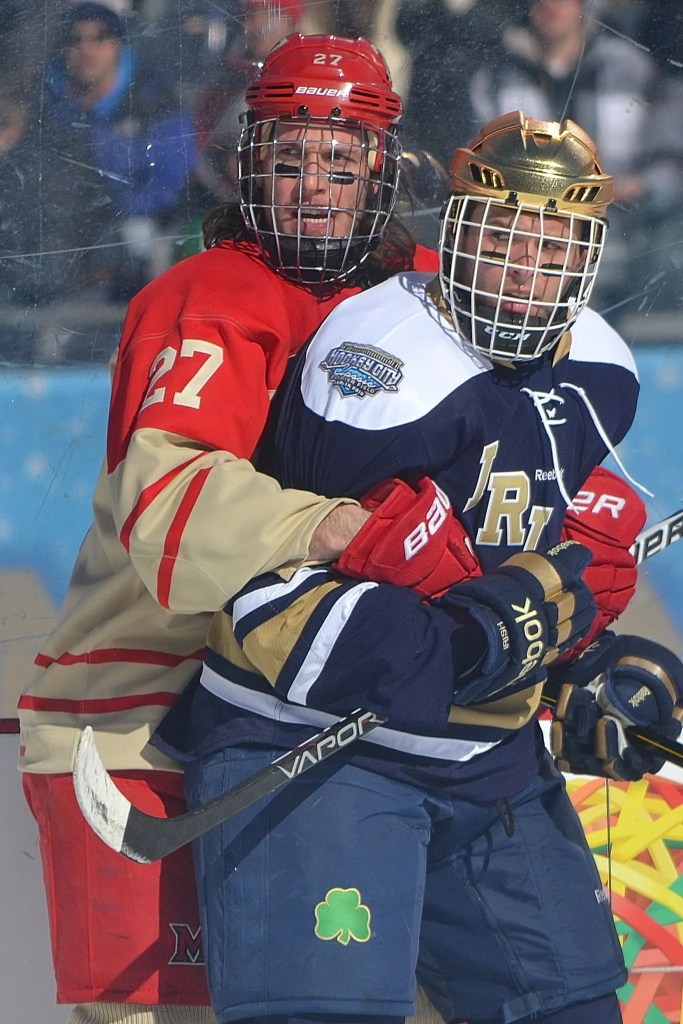
While Marc Hagel never accrued more than 43 penalty minutes in any of his five AHL seasons, Kyle Hagel rolled up at least 150 PIMs five times in that league, including 245 with Rockford in 2010-11.
“Kyle fought everybody,” Marc Hagel said. “There’s plenty of videos of me where I’m scrolling in and out of the frame while Kyle’s either beating someone up or getting beat up, trading blows.”
In the spring of 2013, Kyle Hagel was playing for his hometown Hamilton Bulldogs and was challenged to a fight by Texas Stars opponent Curtis McKenzie, a former Miami standout. McKenzie had joined the Texas Stars, the AHL affiliate of the Dallas Stars, who drafted him, and was playing one of his first professional games.
Kyle Hagel accepted.
The pair had never met before, much less sparred, so after the scrap and the skaters had sat in their respective penalty boxes, Kyle asked McKenzie why he wanted to fight.
McKenzie’s reason? In true hockey enforcer form, McKenzie said it was because he had been his brother’s roommate for the past season at Miami.
“Those two are just two warriors,” Marc Hagel said. “You’re like, I hope everyone’s OK, but they’re probably just going to beat the wheels off each other and have a good one.”
Kyle Hagel ended up in Marc’s division, so the brothers played against each other 12 times.
“Pretty cool to play in the AHL against your brother for a long time,” Marc Hagel said. “That was awesome.”
Marc Hagel continued his professional career in Europe, first leading Norwegan Lorenskog in scoring by going 16-12-28 in 39 games and by captaining the 2018-19 Danish Esbjerg Energy team, which fell in the quarterfinals despite four points in seven games from Hagel.
It was during that season that Hagel decided to hang up the skates and turn pro in another field.
“I was sitting around on my couch in Denmark, I was 30 years old, I was like, OK, I think it’s time,” Hagel said.
Hagel credits chiropractics with taking the pressure off of his brain and nervous system during his concussion bout, leading Hagel to pursue a career in that field.
Canada has only one chiropractic school, Toronto’s Canadian Memorial Chiropractic College, and only 200 students are admitted per year.
Fortunately, Hagel’s earlier stop in Oxford vaulted him to the front of the class.
“Because I had a Master’s degree from Miami, when I applied to chiropractic school in Canada…I automatically went to the top of the grade pool,” Hagel said. “So I was basically guaranteed an interview, and I knew if I got an interview I could probably get in.”
That meant four more years of classes, years after completing an undergraduate degree and a Master’s.
“It was hard,” Hagel said. “I got there on Day 1, I was like, what the hell? I thought we were just cracking backs, and then all in the sudden…it was hard. But I buckled down and put in four years.”
Many sports fans don’t associate chiropractic medicine with concussions, but after several head injuries in such a short period, Hagel said it saved his career.
“All power runs brain, brain stem, spinal cord, out – all power in the body,” Hagel said. “All information (goes) from your spinal cord up to your brain, so that’s what you take care of. It’s the only way you can access the brain besides the scalpel, and you don’t want to do that.”
Now Dr. Hagel, who was the backbone of Miami’s 2012-13 team, has made a career out of helping people in similar situations to the one he overcame at Princeton.
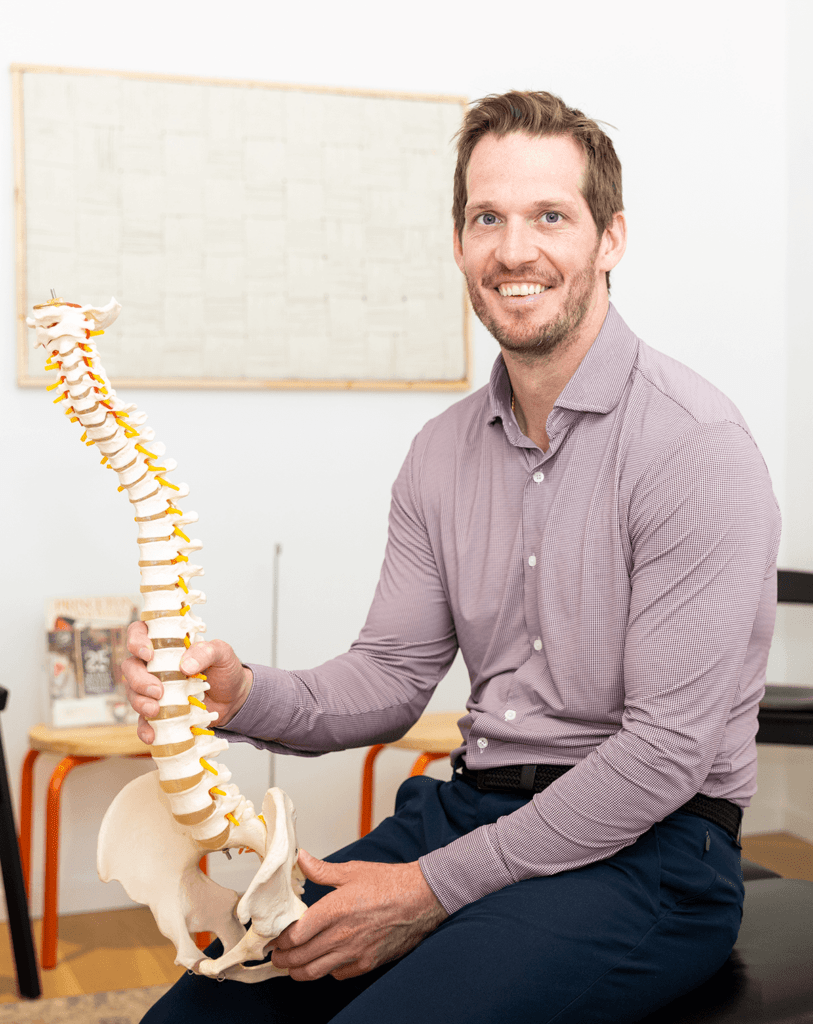
“What I would like to get across, the body, the brain, have infinite healing potential,” Hagel said. “They told me that I’d have…scars on my brain. Well, I played 550 games after that year, including exhibition, pro, couple more college years, Europe. Never missed another shift with head trauma the rest of my career. Graduated chiropractic school with honors. So the brain still works, the brain can recover.”
And hockey, and partially Miami hockey in particular, helped steer Hagel into his consequential line of work.
“Hockey just kept on giving,” Hagel said. “It gave me Princeton, from my older brother to me, it gave me a life lesson I had to learn about taking care of my own health and honestly if I want to be a man and a warrior, I’ve got to take care of myself, then I went to Miami, Miami prepared me for pro hockey but also gave me a professional degree. (I had) a pro career that I’m quite proud of, but when it was time to go back to school, Miami gave me that little bypass into the interview for chiropractic school, and now I just take care of tons of athletes, and see lots of kids that need help and lots of hockey players that need help, and families too.”
————
VFG is headed to Belfast to cover Miami in the Friendship Four this November. We’re a completely independent website, so we bring you RedHawks hockey coverage without a dime of corporate compensation. If you like our work and have the means, please consider helping us continue to provide the best RedHawks coverage and photos by contributing via Venmo here:

 View From the Glass
Great article. As Marc’s Aunt & Uncle we went through all of that with him. Enjoyed every minute of it. Late nights trying to find games on the internet etc.
Thank you
Linda Cassidy
LikeLike
Thanks for the kind words! He’s such a great, articulate guy that he’s easy to write about.
I’ve had his story on my agenda for years and finally found the time this summer.
By the way, I keep an Outdoor Games tab on the site, with over 100 pics from that game at Soldier Field that I referenced. https://viewfromtheglass.com/history/outdoor-games/
LikeLike