With NILs, potential roster limits and the transfer portal, this college hockey off-season has already been the craziest in the entity’s history by a wide margin, and we’re still four months from puck drop in 2025-26.
Throw in Canadian university and juniors athletes being allowed to play for NCAA teams starting this fall, and many fans may feel overwhelmed by the seemingly-daily overhaul to the traditional format.
And followers of Miami hockey just watched their team finish with its worst record in its 47-year history, which in itself has left many seeking answers.
Between Twit-X, website comments and emails, readers have asked us a lot of good questions, with a few having surfaced repeatedly.
VFG has you covered this summer. We opened our mailbag, shooed away all of the moths and tried our best to make sense out of the 500-level quantum physics course that is this college hockey off-season, both from an NCAA and RedHawks perspective.
We’ve broken this into two parts — the first to discuss changes to the college game in general and how that will affect Miami, and the second to talk about the RedHawks’ off-season and where the program is headed.
Here’s Part I:
Q: For the uninitiated, how does hockey development differ from most other sports, where athletes go high school-to-college?
VFG: With a prominent exception or two, if you’re a Division I-caliber hockey player in North America, you play junior hockey. Minnesota is the only state with strong enough high school programs that it produces significant NCAA talent.
The Tier 1 juniors league in the U.S. is the United States Hockey League (USHL), with 16 teams mostly in Iowa and adjacent states. The USHL holds an annual draft for 16-year-olds, and typically players will commit to colleges while in juniors and develop with their respective USHL teams until they’re ready to join their Division I program.
For the super exceptional American hockey prospect, the U.S. National Development Team has a team in that league based out of Plymouth, Mich. Louie Belpedio and Riley Barber are among those that have played for Miami out of the USNDT.
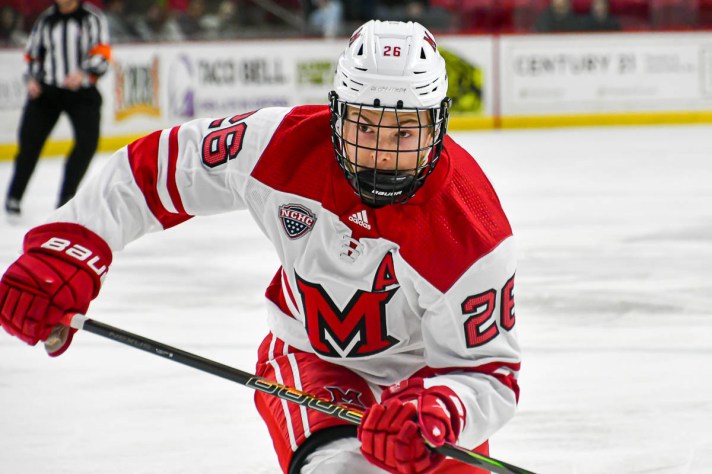
Tier 2 is the North American Hockey League (NAHL), which is a step below but still produces some D-1 talent, such as current alternate captain Blake Mesenburg.
Similarly, Canada has three elite juniors leagues – the Ontario Hockey League, the Quebec Maritimes Junior Hockey League and the Western Hockey League – that all fall under the umbrella of the Canadian Hockey League. So if you see OHL, QMJHL, WHL or CHL referenced in subsequent stories, that’s what those acronyms stand for.
Canada also has U Sports, the Canadian equivalent of the NCAA.
Q: So what changed?
VFG: Prior to this off-season, athletes who played in any of the CHL leagues were considered professional, rendering them NCAA ineligible. That rule was recently struck down, so now college-aged players on all of those teams are eligible to play in the NCAA, assuming they have the necessary credits to enroll in U.S. college.
Additionally, most U Sports athletes developed in the CHL and were therefore disqualified from playing Division I, so they now are NCAA eligible as well.
The CHL leagues have 60 teams, and 48 schools across Canada compete in U Sports men’s hockey.
Q: Holy crap.
VFG: Well put.
Q: How many players have come to the NCAA from Canadian juniors?
VFG: TSN’s website has a tracker, and there’s no ‘last updated’ text, but it looks pretty current and 151 are committed the Division I teams for 2025-26. That’s just under 2½ per NCAA team.
BUT…
With this being such a new phenomenon, a lot of CHL players supposedly hadn’t considered the NCAA route as a potential option, so many have signed with D-1 teams recently.
And it’s rumo(u)red some extremely high-end players are pondering the decision.
We’re talking top-5 overall draft picks like Michael Misa, who had 138 points in the OHL and is a favo(u)rite to be drafted in the top three later this month, and Gavin McKenna, a 2026 draft-eligible forward who could become a generational talent.
The NHL draft is at the end of this month, and a number of CHL players are allegedly waiting until after they’re drafted to see which avenue their team prefers for them to develop.
That means the first week or two of July will be very interesting.
Q: So are U Sports kids coming to the NCAA as well?
VFG: Yes. Not a ton, but a number of players are moving south to further their education.
Q: Has Miami signed players from the CHL or U Sports?
VFG: Yes and yes.
F Kocha Delic (Sudbury, OHL), F Ethan Hay (Kingston, OHL) and D Ryder Thompson (Portland, WHL) are all coming to Oxford from the CHL and D Owen Lalonde (Queens U.) and G Matteo Drobac (Western Ontario) will join the RedHawks from U Sports.
Q: How does CHL and U Sports talent translate to the NCAA?
VFG: That’s what everyone is wondering. The three CHL leagues are very different too (for example, the WHL has a reputation for being more physical), so the answer to that question may vary.
One huge difference is the schedule in the CHL is nearly double that of the NCAA. Division I plays 34 regular season games, and the schedule in all three CHL leagues is in the 60s. Plus teams play way more games in the CHL postseason.
Miami coach Anthony Noreen has said that one benefit of playing fewer games is the ability to concentrate on physical development, which can get lost in juniors when teams play 90 or more games including playoffs and preseason.
But no one really knows how this will work out, which — for someone with a naturally inquiring mind and a front-row seat, literally and figuratively — makes it that much more interesting.
Q: NIL (name, image, likeness) is earning kids huge money in football and basketball, but how do NILs affect Miami and college hockey in general?
VFG: We’re not totally sure yet, but it sounds like there are some definite ‘haves’. Boston University sounds like it’s one of them. Not surprisingly, most of the Big Ten as well.
Obviously information in this field is hard to come by, but it sounds like Miami will be somewhere between a BU/Michigan and the lowest-end Division I schools.
WHL commissioner Dan Near made an interesting point in a recent interview: To the super elite of college hockey who will ultimately earn many millions of dollars, the amount of NIL a player would earn is miniscule, and it’s not worth chasing the stick over, say, $100,000? After seeing several high-end prospects poached by North Dakota, he predicted that a number of CHL players that jumped to the NCAA would be home by Christmas.
And we have to take Near seriously, since he earned his Masters in business administration at Miami.
Brad Schlossman, the North Dakota beat writer for the Grand Forks Herald and one of the most respected writers in college hockey, predicts most CHL first- and second-round picks will defect to the NCAA.
The answer is probably somewhere in between, although tons of talent has shifted from the CHL to the NCAA in recent weeks with undoubtedly more blue chippers to come.
Q: Talk is non-Americans can’t earn NIL money. Is that true?
VFG: Our understanding at present is that non-Americans can’t earn NIL money in the U.S. However, they can earn money in their home country for endorsements, commercials, etc. But information on this subject seems to change by the minute.
Q: The House settlement was just released. How does that affect Miami?
VFG: Miami ‘opted in’, which means it agreed to revenue share with its student-athletes. Schools weren’t allowed to pick and choose sports, so opting in applies to all of MU’s athletic programs.
The maximum amount Miami can play its hockey players is yet to be determined, but a cap of $20.5 million has been tossed around the internet with regularity. That figure will vary by school and change annually.
Q: What’s your take on all of these changes?
VFG: I have very mixed feelings.
One of my favorite moments in Cady Arena was a game in early 2015 when Duluth was in town. The teams tied, 4-4. It was one of the best hockey games I’ve ever seen, because the talent level on both sides was off the charts.
Miami was a No. 1 seed in the NCAA Tournament that season, and the Bulldogs advanced to the regional final.
So a big part of me wants to see the very best hockey played in Oxford. I’d rather see Miami qualify for the NCAAs with 22 wins through a gauntlet schedule than 28 wins against a bunch of cupcakes.
The talent level in the NCAA is going to get a lot better, no doubt. Guys that will be drafted in the top five overall this year and next are rumored to be joining Division I teams this season.
I like that CHL kids now have the option to play college hockey, which has never been better and will see the level of play augment significantly in with the influx of Canadian studs.
But I don’t like that coming at the expense of U.S. kids’ jobs either.
I also don’t like the uncertainty it creates this far into the off-season.
I remember before COVID, Miami’s former SID would joke with me about my eagerness to see the following season’s roster on the site. That was typically released in May.
It’s the second week of June and no team in college hockey has a clue how its 2025-26 roster will ultimately look, and it may be quite a while until they do.
We mentioned above that some players may wait until after the NHL draft to decide where they’ll play next season.
So in July, Bobby might get a call that goes, sorry, I know you dreamt of playing for us your entire life, and we thought we had a spot for you, but we just signed a kid that had never even considered NCAA hockey until three months ago, and now you’ll have to find another team to play for.
Classes start in six weeks. Good luck kid!
In the coaches’ defense, their job is to win hockey games, and they must do whatever is necessary to talent-load their teams.
Regardless of how people feel about paying college players, it’s here, and expect more hurt feelings than ever across the Division I panorama.
In a perfect world, it would be nice if there was an end date for signees. As in, kids can’t get bumped off rosters after a certain date, which will undoubtedly happen to a number of players this summer.
Speaking of pipe dreams, college hockey also needs an import cap. The CHL has one. MLS has one.
Nothing against those players, as most Canadians and Europeans that go the NCAA route excel in the classroom and are model student-athletes.
But the NCAA is the primary — and nearly exclusive — development entity for American hockey players. Canada has the CHL. The Europeans have their own juniors leagues.
Hockey thrives in so many areas across the country because of the NCAA, and seeing American kids squeezed out of jobs in large numbers isn’t good for the sport in the U.S.

 View From the Glass
One thought on “View From the Glass Q&A, Part I”