
OXFORD, Ohio — The best Division I hockey coaching job available this off-season was the one at Miami, and MU brass feel it secured the top candidate in a crowded field.
Anthony Noreen was officially welcomed to Miami in a press conference at the Goggin Ice Center on Tuesday, at which athletic director David Sayler explained his choice.
“What I think we’ve found is someone with contagious energy,” Sayler said. “Someone that is constantly willing to engage in conversations, really dig deep into somebody about why they want to be a hockey player, and be an elite hockey player, and how to help develop them as a person. Those were some things that were really important, that energy, positive approach, someone that knows what high-end talent looks like…obviously, that’s where I want to take this program, and it’s going to take getting that talent in the door. Next is developing those players, making them better hockey players on and off the ice — that’s important here at Miami. And really what that’s going to do is bring buy-in, and it’s going to create a culture. And that culture is ultimately going to lead to winning if it’s done right.”
Despite not having previously played or coached at Miami — making him the first non-alumnus hired for this role since 1994 — Noreen called this a dream job.
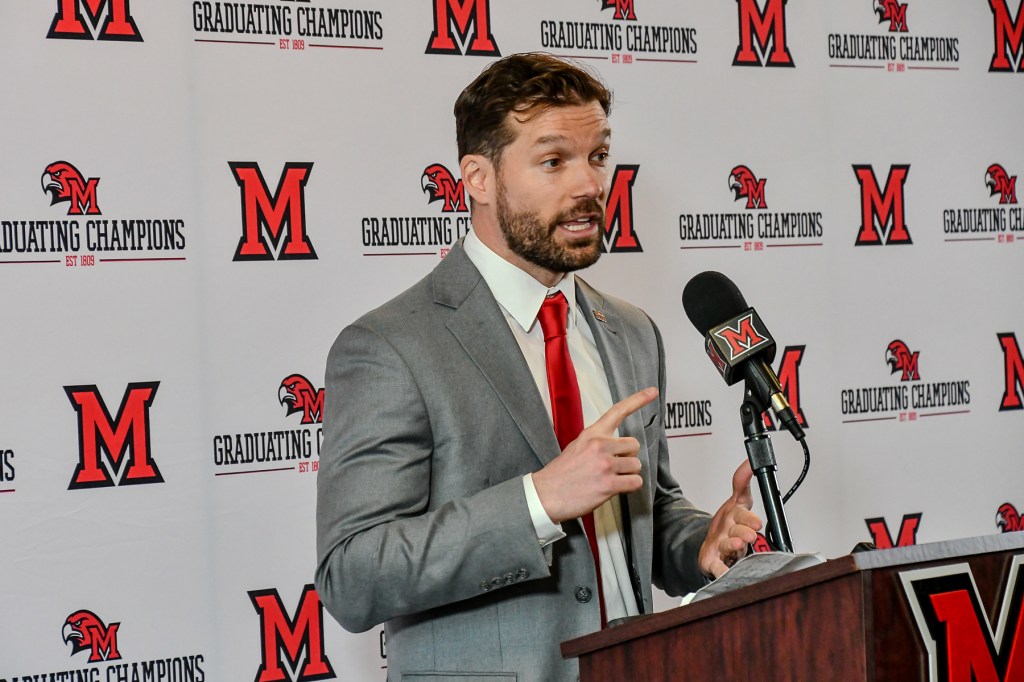
“When I walked into this opportunity, into really the first conversation, via Zoom, it’s been pretty clear to me the past few years that if I was going to move somewhere, the No. 1 thing for me was to make sure that I was morally and philosophically aligned with the people I was going to go work with, and in this case with the university as well,” Noreen said. “And I think really from our first conversation, we were just speaking the same language, and I don’t speak the same language as a lot of people.”
As someone who was simultaneously president of hockey operations and head coach — and is still finishing out the season in those roles for one of the most successful USHL teams the past few years in Nebraska-based Tri-City — Noreen has established a track record of flipping downtrodden teams to winners.
Immediately after completing his Bachelor of Science degree at UW-Stevens Point, he shifted into an assistant role with the Division III team as a 24-year-old, and his alma mater surged from 7-18-2 in 2006-07 to 29-19-6 the next two seasons.
USHL Youngstown finished with just 44 points in 2009-10, last in its conference and second-worst in the league, but after hiring Noreen, the rejuvenated Phantoms vaulted to 72 points within two years. They won 40 regular-season games in 2014-15, partly thanks to Kiefer Sherwood and Josh Melnick, both of whom would later commit to and thrive at Miami and in the pros.
Tri-City, which also struggled several years ago, has thrived under Noreen’s tutelage, twice winning 45-plus games in the USHL’s 62-game regular season.
Between his two USHL stops, Noreen has been named that league’s coach of the year three times.
“This was a time when I felt we really needed to hire someone that could manage a roster — really be the CEO of a program,” Sayler said. “You’re in charge of everything that happens. There are a lot of external forces pulling at you, hitting you. (Noreen) is someone that’s frankly been a president and GM-slash, and head coach of a team.”
Noreen’s credentials are solid, no doubt, but a move to a Division I program — especially one playing in college hockey’s best league — is an Evel Knievel-level jump with a pool of hungry crocodiles waiting below.
But one of the most obvious recent success stories is that of Boston College coach Greg Brown. His top-ranked Eagles will play for the NCAA title on Saturday in just his second season at BC after coaching current RedHawks Michael Feenstra, Zane Demsey and William Hallen at USHL Dubuque in 2021-22.
Miami finished an NCHC all-time worst 1-21-2 in league play this season and calls have come from the previous coaching staff, some boosters and fans to vacate the conference.
“You want to play against the best, I think that’s how you grow, I think that’s how you get better,” Noreen said. “The league is unforgiving. I’ve watched a ton of games in the league, the room for error is nil. I think that’s why there’s so many guys that move on from here and have success from here. At my level, you say the same thing about the USHL. You want a guy to come (here) because you know that they can turn into, and I think it’s the same thing here. I think we need to buy completely into that. Obviously, we just need to operate at a higher level.”
It’s encouraging that while many teams have seen their rosters implode this off-season due to the transfer portal, just one player — Robby Drazner — has bolted since Noreen was named Miami head coach last week.
And within 48 hours of Noreen’s hiring, defenseman Shaun McEwen decommitted from UMass — despite being a Massachusetts native whose grandfather coached the Minutemen — and committed to Miami, and Quinnipiac senior top-six forward and Christophe Fillion agreed to join the RedHawks.
Forward Matt Choupani also announced his commitment to the RedHawks this week after recording 41 points in three seasons at Northeastern.
It’s certainly encouraging that Miami’s roster is net plus-2 since Noreen’s hiring, but part of the reason for the RedHawks’ portal pause may be due to current players’ role uncertainty moving forward, so MU may not be done shedding players.
Noreen — who will make a $335,000 base salary over his six-year contract ($10,000 more than Chris Bergeron earned in 2023-24) — obviously has not had adequate time to delve deeply into that realm just 11 days into the job, especially since he’s still coaching/running a USHL team in central Nebraska while trying to retain previous 2024-25 commits and secure supplemental talent for the upcoming season and beyond.
“The credit I will give to this place — and it’s not like that a lot of other places — new coach, coaching changes, it’s almost an easy out — these guys all want to be here,” Noreen said. “Every guy that’s on that roster, even the fifth-year guys, they want to be here. They want to stay here. Same thing with the staff. I think that’s a huge credit to Miami University, to Oxford. For us, it’s knowing what changes we might make, being honest with (the players) so they know what the situation is going to be — the ever-flowing, changing situation.”
On paper, Miami also boasts a solid incoming class this fall, and Noreen said he has already contacted everyone currently committed to joining the RedHawks this fall, a group that includes three more Europeans, one of which is 6-feet-3 forward and Boston Bruins draftee Casper Nassen.
“I have multiple former coaches that are head coaches, GMs, across the USHL, so there’s a lot people that I know and trust, and I like to think the feeling is mutual to where they’ll be a trusting relationship to that (players) will be in good hands here,” Noreen said.
Everything about this hire sounds right, and for one of the first times in a while, it felt really good to be a Miami hockey fan.
But for RedHawks supporters, it’s a well-entrenched apprehensive enthusiasm, conjuring memories of a similar message they heard five years ago that aged poorly.
And Miami fans have justifiably developed significant scar tissue, not only as been-burned-before, rebound-relationship victims that have not seen Miami finish above .500 in nine seasons, but dating back to one of the most horrific losses in college history in 2009.
That’s when the RedHawks lost, 4-3 to Boston University in the NCAA title game, squandering a two-goal lead in the final minute of regulation and surrendering the decisive marker 10 minutes into overtime.
So Noreen inherits a program that has suffered through nine seasons of utter futility and a horrific Division I championship game loss six years prior.
But if he rejuvenates Miami hockey to a level anywhere near its heyday run like he believes he can, Noreen could attain legendary status in Oxford.
“We’re going to face the facts: We need to get better,” Noreen said. “We need to get better, just like we need to get better tomorrow, just like we need to get better next week. That’s not going to change if we want to do what I know the guys in that (locker) room want to do, and I know people sitting in this room want to see the program do. I feel like we’ve got the facilities, the campus, the support to do that. Ultimately we need the discipline to stick to that.”

 View From the Glass